

Dr. Audrey Borowski (Cambridge):
Leibniz, a Projector for the Early Modern Age
Donnerstag, den 15. Oktober 2026, 17.00 Uhr
Dieser Vortrag findet nur online und in englischer Sprache statt.
Hierzu wird um Anmeldung gebeten unter: info@leibnizgesellschaft.de – Nach Anmeldung erhalten Sie die Zugangsdaten am Tag vor der Veranstaltung.
Zum Vortrag
Described by Voltaire as “perhaps a man of the most universal learning in Europe”, Gottfried Wilhelm Leibniz (1646–1716) is often portrayed as a rationalist and philosopher who was wholly detached from the worldly concerns of his contemporaries. As my talk shows, this could not be further from the truth. Leibniz, especially as a young man, was a veritable powerhouse of ideas for concrete problems and improvement. Leibniz was an audacious young man encouraged by the ambient sense of epistemological opening and fluidity. The staggering range of his activities included publishing articles, promoting scientific and philosophical societies as well as a universal language, seeking to acquire the secret of phosphorus, inventing a calculating machine, and advocating for engineering projects and newfound medical measures. Famously he devised a plan for a universal philosophical language and encyclopaedia that would provide an archive of all knowledge through a combinatorial art, centuries before large language models, and even imagined enlightened princes promoting metaphysically inspired technocracies redesigned along rational and scientific lines. Ultimately, however, many of his schemes did not succeed or remained unimplemented. As he would find out quickly enough, willing as Leibniz was ready to place his knowledge in the service of power, power did not in turn feel obliged to implement his schemes or cater to his vision of learning.
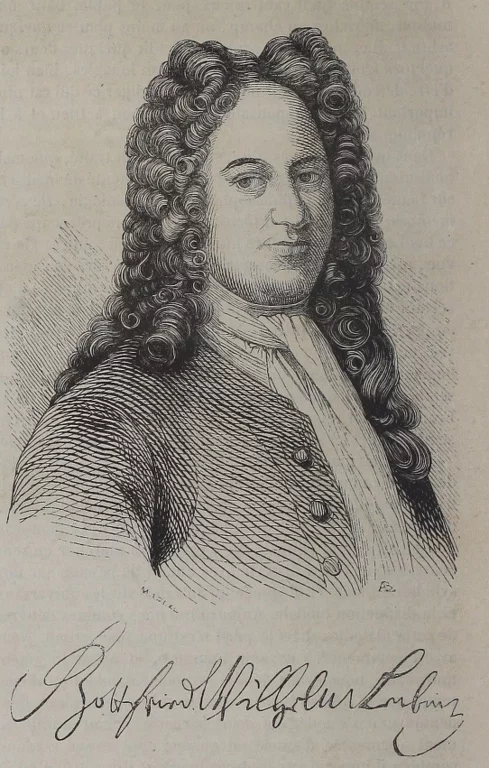
Abb.: Le Magasin pittoresque 11 (1843), S. 80, https://archive.org/details/lemagasinpittore1112unse/
Referentin
Audrey Borowski is a Leverhulme Early Career Fellow and Isaac Newton Trust Fellow at the University of Cambridge working on the philosophy of artificial intelligence. She was previously a postdoctoral Research Fellow at the Munich Centre for Mathematical Philosophy as well as the University of Bonn. She completed her doctorate (D.Phil) in the History of Ideas at the University of Oxford. Her first monograph Leibniz in His World: The Making of a Savant was published by Princeton University Press in 2024.

Gefördert durch die VGH Versicherungen
Am Freitag, 13. November 2026, findet ab 16.00 Uhr die diesjährige Mitgliederversammlung der Gottfried-Wilhelm-Leibniz-Gesellschaft sowie ab 17.00 Uhr der öffentliche Jahresvortrag im Vortragssaal der Gottfried Wilhelm Leibniz Bibliothek statt.
Am 19. November
2026 findet im Rahmen des 350-jährigen Jubiläums der
Ankunft von Gottfried Wilhelm Leibniz in Hannover und in Kooperation mit
dem Studio Artistico Hannover eine Veranstaltung zum
UNESCO Welttag der
Philosophie 2026 statt. Geplant sind folgende Vorträge:
Dr. Annette von Boetticher (Hannover):
Leibniz und die „Wolfenbütteler
Wissenschaftsszene“; Prof. Dr. Peter Nickl (Regensburg/
Hannover): Leibniz und die Heiligen; Prof. Dr. Stefania
Centrone (München): Leibniz und Gott. Ort:
Vortragssaal der Gottfried Wilhelm Leibniz Bibliothek. Beginn ab 15.00 Uhr.
Eintritt frei.
Weitere Informationen unter:
www.leibniz-kommt-nach-hannover.de